
Introduction
Model development and data-driven decision-making have long been foundational capabilities at BMO. Over the years, we have built increasingly sophisticated models to predict client behavior, risk, fraud, and operational outcomes, all in service of driving measurable business value. This ensures better outcomes for our clients and faster decisions for our teams. Yet a persistent challenge remains: the tension between predictive performance and interpretability.
Highly predictive models often function as black boxes, producing accurate forecasts with limited transparency into the factors driving those outcomes. This is largely structural where the accuracy gains come from capturing high-order, non-linear interactions across thousands of features, and the very complexity that lets a model represent those interactions is what makes any single prediction difficult to attribute to a small set of readily explainable drivers. More interpretable approaches provide greater visibility into model behaviour, but frequently at the expense of predictive performance. As our organization continues to advance machine learning and AI, the opportunity is to convert increasingly sophisticated predictions into decision intelligence that is transparent, governed, and designed to support responsible business outcomes. Large language models (LLMs) and agent-based systems offer an opportunity to bridge this divide. However, the hardest problem is not building the agent itself; it is solving the translation problem that exists beneath it. Kristin Milchanowski explores this challenge in her book, Return on Intelligence, in Principle 18, “Reveal Hidden ROI”. This principle reframes agents as more than simply task automation tools; they are mechanisms for discovering insights and creating continuous learning loops. Closing that gap requires more than good prompt engineering; it takes a system that can turn model output into a recommendation the business can act on with clear, supporting rationale and feedback that strengthens future decisions.
The translation layer
Statistical outputs and business decisions exist in fundamentally different domains: one is technical and probabilistic, the other operational and economics oriented. In practice, predictive models are rarely inaccurate. More often, they fail because their outputs are difficult to operationalize.
A propensity score or risk estimate may provide significant value to a data scientist, but business stakeholders are typically trying to answer a different set of questions.
Historically, organizations have attempted to answer these questions through dashboards, feature importance visualizations, scorecards, rule-based systems, and manually curated explanations. While effective in some contexts, these approaches are often static, difficult to maintain, and disconnected from business decision workflows. Most importantly, they place the burden of interpretation on the user. The model generates a prediction, and the business stakeholder is responsible for translating that prediction into action.
| Business question | → Translation Mechanism → | Model artifact |
|---|---|---|
| Why was the prediction made? | Attribution over model internals | Feature attributions / SHAP values |
| What factors contributed to it? | Ranking and grouping of drivers | Weighted feature contributions |
| What actions are available? | Mapping drivers to an action catalogue | Eligible intervention set |
| Which action is most likely to improve the outcome? | Counterfactual / uplift estimation | Predicted delta per action |
| What evidence supports that recommendation? | Retrieval of supporting cases and policy | Cited precedents and rules |
In many cases the translation is exactly what governance, the use case, or end users require. A relationship manager reviewing several accounts should be interpreting the model, applying judgment the system does not have, and owning the decision. Interpretation is a feature there and important to ensure the quality of AI is held to a high standard. Our objective was to move that translation step into the system itself.
From prediction engines to decision engines
Our goal was not simply to place a conversational interface on top of an existing model. Instead, we sought to extend a prediction engine into a decision engine, preserving everything the predictive model already does well and building the decision layer on top of it.
To accomplish this, we designed an architecture consisting of three complementary layers:
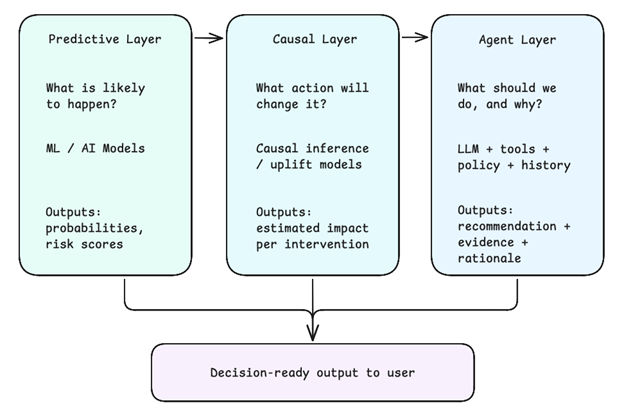
1. Predictive layer: Estimates what is likely to happen
This layer contains traditional machine learning or AI models that quantify future risk or opportunity. Depending on the use case, this may be a client’s acquisition probability, a fraud likelihood score, a credit risk estimate, or some other prediction.
2. Causal layer: Estimates what actions are most likely to influence the outcome
Traditional predictive models are designed to answer:
- What is likely to happen?
They are not designed to answer:
- What intervention will change what happens?
This distinction is critical. By applying causal inference techniques, we can estimate the incremental impact of different interventions and distinguish actions that are merely correlated with successful outcomes from those that are likely to drive them.
3. Agent layer: The translation mechanism
This combines model predictions, causal insights, business policies, historical outcomes, and contextual information to generate decision-ready recommendations. Rather than surfacing raw model outputs, the agent produces explanations, supporting evidence, and recommended actions that align with business objectives.
The result is a system that moves beyond prediction and toward decision support.
Designing for trust
While LLMs are highly effective at synthesizing information and generating natural language explanations, they can also introduce reasoning that is difficult to validate. For decision-support applications within a financial institution, explainability and auditability are essential.
To address this, we designed the workflow such that recommendations are grounded in structured outputs from predictive models, causal inference frameworks, business policies, and approved contextual data. This approach preserves the strengths of traditional machine learning and AI, statistical rigor, reproducibility, and measurable performance, while leveraging LLMs to improve accessibility and usability. The objective is not to replace predictive models with agents, but rather to augment them with agents that can transform predictions into actional recommendations supported by clear rationale.
A practical example: Clients attrition
Consider a client’s attrition model that predicts a client has a 78% probability of leaving the bank within the next four to six months.
From a modeling perspective, this is a valuable prediction. The model may have identified patterns such as declining product utilization, decreased digital engagement, reduced account balances, or changing transactional behavior. These signals collectively indicate elevated attrition risk.
Traditionally, the output presented to a stakeholder would consist of a risk score accompanied by feature importance metrics explaining the primary drivers of the prediction.
While useful, this still leaves a critical question unanswered: What should we do about it?
This is where the decision intelligence architecture becomes valuable.
Rather than presenting a list of contributing factors, the system can explain that the client has demonstrated a sustained decline in engagement across several products over multiple quarters—a pattern that has historically preceded the loss of a primary banking relationship.
The next step is the one that matters most, and it is the one predictive models alone cannot take: determining whether any intervention can change that outcome. Understanding clients as individuals and personalizing their experience while maintaining their trust has always been central to how BMO operates, so it is only natural we incorporate this into our AI systems. Causal inference is how we bring that same standard into the model layer. It lets us ask not just what a client is likely to do, but what they need to maintain a productive and positive relationship with the organization.
Using causal inference, we can estimate the expected impact of different interventions. For example, analysis may reveal that certain clients segments that receive proactive outreach from a relationship manager experienced materially lower attrition rates, while clients that receive generic promotional offers demonstrate little measurable improvement. The distinction is important. The recommended action is not selected because it is associated with successful outcomes, but because there is evidence that the intervention itself contributes to a better outcome.
The agent then combines these insights into a business-ready recommendation, explaining:
- why the client is at risk,
- what evidence supports that assessment,
- which intervention is expected to have the greatest impact, and
- how confident we are in that recommendation.
The output is not a database lookup with better grammar. It is a narrative: a coherent account of what is happening to this client, what the evidence for that is, what could be done about it, and how much confidence we have in the answer. That narrative is grounded in data, but it is delivered in the language of the decision the user must make. Translation is the product.
The predictive layer answers: What is likely to happen?
The causal layer answers: What actions can change what is likely to happen?
The agent layer answers: Given those insights, what should we do next? Together, these capabilities transform a predictive system into a decision-support system.
Conclusion
For decades, predictive analytics has focused on forecasting future outcomes. While prediction remains essential, business value is ultimately realized through action.
The combination of model development, causal inference, and agent-based systems allows us to move beyond answering what will happen and begin answering a more important question: how do we best support our clients in business and in life?
Better predictions are not the bottleneck. Getting from a prediction to a decision someone will make is.

